Archive for the 'Think about it.' Category
9th August 2013
Read it.
1. One person (or two people) did not have the ancestral state of all of our DNA.
The person whose cells housed the common mtDNA ancestor (or Y ancestor) also had all of the other chromosomes (1-22 and X), but did not house the common ancestor of each of these chromosomes. These non-sex chromosomes are a lot more complicated. This touches on why it is also misleading to refer to the common ancestor of genetic “males” versus “females.” Genetic females are not only their mtDNA – we also have 22 non-sex chromosomes, and two X chromosomes! Genetic males are not only their Y (and mtDNA), they also have 22 non-sex chromosomes and one X chromosome! Because the non-sex chromosomes (autosomes) can swap DNA, and are inherited through both the sperm and the egg, they much more complicated history than the Y and mtDNA.
2. A lower bound, not a point estimate.
Tracing back to the common ancestral mtDNA or the common ancestral Y chromosome does not tell us when anatomically modern humans arose. We can estimate the TMRCA, or the Time to the Most Recent Common Ancestor, but this mtDNA surely existed much further back in time.
Posted in Think about it. | Comments Off on Y and mtDNA are not Adam and Eve: Part 2 – What it means to be the Most Recent Common Ancestor?
9th August 2013
Read it.
I was interviewed by two different science writers to comment on this paper, and in both interviews I stressed how inappropriate the “Adam Y” and mitochondrial or “mtDNA Eve” analogies are. You can see how well they took that into consideration: here and here. I really enjoyed talking with the journalists, so hope they won’t think I’m picking on them either because, to be fair, nearly every popSci article used this analogy (see here, here, here, and here). I’ll take a sentence here to especially note the article by Francie Diep, here, that took a different approach.
While I have several reasons to disliking this analogy, I cannot fault the journalists completely for using it in this instance. Aside from my protests, there is no reason science journalists should think that it is a bad analogy, because it was used in the manuscript (without context or explanation).
Posted in Think about it. | Comments Off on Y and mtDNA are not Adam and Eve: Part 1
9th August 2013
Read it.
Of all fallacies, ad hominem endures the harshest abuse, yet we all know in our hearts that it really does matter that Michael Moore is fat
Which is where Bradley Manning comes in.
…
Isn’t the more pressing question really “What the hell kind of army lets a twink like this join in the first place?”
Posted in Think about it. | Comments Off on From Purple Hearts to Pink Badges
9th August 2013
Steve Sailer waxes dyspeptic.
As for my influence, I’ve been writing a long time, and I’m stoic about the fact that my influence works through labyrinthine laundering processes, where my ideas eventually show up in more sonorous forms on the op-ed page of the New York Times weeks or months or years after I publish them. Eventually, I expect to be recognized as The Guy Who Figured Out the Answers to the Hard Questions, but I don’t expect that to happen before I’m very old. Such is the way of the world …
On the other hand, the media conventional wisdom considers Bryan’s extremism to be admirable, if perhaps a little too forthright for the peasants at the moment. Unfortunately, it’s not a good idea to blithely assume that elites won’t get what they keep shouting for, no matter how stupid it is. To update for the 21st Century H.L. Mencken’s apothegm on democracy, “Mediacracy is the theory that the elites know what they want, and deserve to get it good and hard.”
The problem is that there can be a lot of collateral damage when sanity is considered unmentionable in elite discourse.
That America is better than other places is obvious from the fact that a lot of people want to move from There to Here. It seems obvious to me that those who are Here ought to want to keep Here as good a place as possible, and I don’t see in what way that’s a bad thing; how does letting in a lot of people from There do that? They have equally obviously not been very successful at making There a better place, otherwise they would want to stay There.
So how do we keep Here the place we want it to be, and keep it from becoming Just Another There? The experience of the European countries is, I think, instructive — never have so many from There been allowed into Here, and the results have been invariably negative — for every 10 things good about such ‘diversity’, there are 100 things bad. Ought we not to learn from the mistakes of others? Do we have to keep reinventing the wheel (or, more accurately, the rack)? The whole ‘come one, come all’ attitude makes absolutely no sense to me.
Posted in Think about it. | Comments Off on Caplan on Sailer
8th August 2013
Steve Sailer connects the dots.
With Barack Obama having Wall Street’s back over the last five years (i.e., virtually no prosecutions for the events leading up to 2008), it’s only natural that Silicon Valley leaders have been thinking about getting their own tame black President, too: namely, Cory Booker, a former Stanford football player, whose job as mayor of Newark makes it easy for him to hit the national broadcasts out of New York City.
I haven’t paid too much attention to Booker, but he seems like a more energetic and prepossessing personality than Obama, so the notion seems plausible that in a country with a large demand for black Presidents but a small supply of plausible ones, Booker would be worth investing money in.
Posted in Think about it. | Comments Off on Silicon Valley Wants Its Own Tame Black President
7th August 2013
Read it.
Conservatives and liberals alike may be surprised to find that in reality John C. Calhoun, a South Carolina antebellum statesman and political theorist, and his pro-slavery allies, stand firmly as the intellectual forebears of the political philosophy of Woodrow Wilson, FDR, and the modern left. Calhoun and the antebellum thinkers behind the positive defense of slavery in the nineteenth century represent the first major criticism of American founding principles – principles the American conservative movement seeks to preserve – as well as the intellectual seed for the later Progressive movement and what is considered modern-day liberalism.
Posted in Think about it. | Comments Off on ‘The Very Best Form of Socialism’: The Pro-Slavery Roots of the Modern Left
7th August 2013
Read it.
In all of these examples, building infrastructure was never the engine of growth, but rather a lagging indicator of growth that had already occurred in the private sector. And when the infrastructure was built, it was often best done privately, at least until the market grew so large as to demand a wider public role, as with the need for an interstate-highway system in the mid 1950s.
There is a lesson here for President Obama: Government “investment” in infrastructure is often wasteful and tends to support decaying or stagnant technologies. Let the entrepreneurs decide what infrastructure the country needs, and most of the time they will build it themselves.
Posted in Think about it. | Comments Off on Obama’s False History of Public Investment
6th August 2013
Read it.
What I have decided is that the Buckley Rule is a stupid rule because it is not a rule, but a saying jackasses use to crap on candidates they don’t like. They did not think Marco Rubio, Ted Cruz, Mike Lee, Rand Paul, Pat Toomey and many others in the Senate and House were electable.
While they would point out, similarly, a list of conservatives who did not win, I’d say that’s the point. Views on electability differ and I don’t think you or I should take anyone else’s word for it. We should see for ourselves.
RedState’s rule is simple. We back the conservative in the primary and the Republican in the general. If fortune smiles, we wind up beating the squish in the primary and winning the general. It does not always work out that way, but often it does. There are a lot of Republican incumbents who suck. They are neither kings, nor princes, nor dukes. They do not get to dwell in the seat until they themselves decide to vacate the seat. The people are allowed to boot them out of the seat.
And I’m happy to help do that.
Posted in Think about it. | Comments Off on Red State Rule
5th August 2013
Read it.
Young children almost universally produce lactase and can digest the lactose in their mother’s milk. But as they mature, most switch off the lactase gene. Only 35% of the human population can digest lactose beyond the age of about seven or eight (ref. 2). “If you’re lactose intolerant and you drink half a pint of milk, you’re going to be really ill. Explosive diarrhoea — dysentery essentially,” says Oliver Craig, an archaeologist at the University of York, UK. “I’m not saying it’s lethal, but it’s quite unpleasant.”
Hmmm. I hear ‘enhanced interrogation technique’….
Posted in Think about it. | Comments Off on Archaeology: The Milk Revolution
5th August 2013
Antiplanner pushes back against the latest Crustian jawboning.
“All the studies show” that the millenials “want to live where they can walk, whether that’s the city or an urban suburb,” she tells Washington Post reporter Paul Windle. Gallaher herself lives in New York City’s West Village, while Windle lives in inner Washington, DC, so their own personal anecdotal evidence easily confirms what “all the studies show.”
All the studies are done by academics who live in cities and know little about places where kids ride bicycles on the sidewalk.
Suburbs need to re-invent themselves, says Gallagher, by providing “A place people want to walk around. Organic, village-type environments that are how the suburbs started to begin with. Public transit also. People want out of their cars, especially millennials.” Again, the verdict is still out about whether millennials “want” out of their cars; somehow, I suspect US DOT researcher Don Pickrell is correct (as previously noted here) that high unemployment rates have more to do with the reduced amount of driving they do at the moment.
Let’s say Gallagher is right and young people will prefer to live in mixed-use developments and use transit over driving. Gallagher’s solution is to turn the suburbs into West Villages (or, going back to the real founder of the New Urbanist movement, Jane Jacobs, Greenwich Villages). That’s an invitation for urban planners to do all sorts of expensive and intrusive meddling into people’s lives.
And that’s what they’re really after — people living their lives according to Crustian prescriptions rather than their own preferences.
Posted in Think about it. | Comments Off on The Suburbs Are Still Alive
4th August 2013
Read it.
Enter the world of food distribution, however, and you all but travel back in time to the last century. Much as it was done throughout the 1900s, food distributors use a largely paper-based system and onsite visits to take orders and payments. Phone orders and fax are widely used, sure, but ecommerce options – even basic email – are scarcely found.
As a restaurant owner (and technophile) this frustrating situation is something I constantly agonize over. And notably it runs contrary to other parts of the restaurant industry, where automation and efficiency are driving innovation. Owning a restaurant is highly stressful and the margins are slim, so entrepreneurs like myself need every bit of efficiency we can get, and I believe tech is the answer.
Posted in Think about it. | Comments Off on A Chef’s Plea to Disrupt the Antiquated Food Supply Chain
4th August 2013
Read it.
While Weinberg and Scott stress that they have studied data only for one university (and urge similar research at other institutions), they also suggest that the logic behind lifting mandatory retirement for higher education was flawed. Most other employers were barred by law in 1986 from using mandatory retirement, but colleges were given an exemption for a while, based on concerns that delays in retirement would make it difficult for colleges to hire people in emerging disciplines, and to diversify their faculties. But Weinberg and Scott note that these arguments became considerably weaker when the National Research Council issued a study in 1991 predicting that those things would not happen.
Posted in Think about it. | Comments Off on New Study Shows Professors Won’t Retire
4th August 2013
Read it.
Kim Ki-hoon earns $4 million a year in South Korea, where he is known as a rock-star teacher—a combination of words not typically heard in the rest of the world. Mr. Kim has been teaching for over 20 years, all of them in the country’s private, after-school tutoring academies, known as hagwons. Unlike most teachers across the globe, he is paid according to the demand for his skills—and he is in high demand.
Posted in Think about it. | Comments Off on The $4 Million Teacher
3rd August 2013
Read it. And watch the video.
For decades from 1714, experts and enthusiasts submitted their ideas to the Board of Longitude in the hope of winning a £20,000 prize – worth £1.5m in today’s money.
Now, the full story of attempts to solve the longitude problem is available in Cambridge University’s Digital Library – with documents and drawings online. Here, with Cambridge historian Prof Simon Schaffer, look at some of the ideas that failed, and the timepiece credited with providing the solution.
Posted in Think about it. | Comments Off on The Crazy Ideas That Failed to Solve the Longitude Problem
3rd August 2013
Read it.
CNN reports that dozens of CIA agents were on the ground there — and that they’re being pressured to keep quiet. Why?
As Nixon learned to his sorrow, and as many have had their noses rubbed in it since, it’s not the original situation but the coverup that will get you.
Posted in Think about it. | Comments Off on The Attack in Benghazi: Worth Investigating After All
31st July 2013
Read it.
‘Where does he get those wonderful toys?’
Posted in Think about it. | Comments Off on The Price of Being a Superhero in Real Life: Then & Now
31st July 2013
Good advice.
You should also click on the link and look at the pictures of the people involved, because it will help you to follow the advice I’ve previously given which is to avoid marrying anyone who looks like she could be on a “Real Housewives” show.
Posted in Think about it. | Comments Off on Don’t Appear on a Reality TV Show if You Are Doing Illegal Stuff
31st July 2013
Fisking Steven Pinker.
Predictions about the future of humankind are better left in the hands of writers who see human nature whole, and who are not out to prove that it can be shaped or contained by the kinds of “liberal” institutions that Pinker so obviously favors.
Posted in Think about it. | Comments Off on The Fallacy of Human Progress
30th July 2013
Read it.
None of the Internet giants have unionized employees, which has made Silicon Valley a favorite target for civil libertarians.
Ponder the assumption that not having unionized employees makes you a target for ‘civil libertarians’. Ponder what that says about those who pass as ‘civil libertarians’ today.
There’s a very good reason why unions have never had a presence in Silicon Valley: they aren’t fans of technology. Labor unions have aggressively fought Uber and Lyft, which threaten taxi drivers with increased competition. They’ve effectively paralyzed a multi-billion-dollar sharing economy industry from spreading around the country.
Unions — dinosaurs from an earlier age. And it makes perfect sense; unions are about getting benefits for workers, and modern technology is focused on machines doing work that people used to do. Unions and technology are natural enemies.
Not to be outdone, one of the largest labor unions in the country, AFL-CIO, is the leading opponent of more high-skilled immigrants, calling the tech community “greedy” for wanting to make it easier to hire foreign engineers.
While, of course, unions aren’t greedy for wanting to stick the ‘tech community’ with higher costs.
Posted in Think about it. | Comments Off on Why Labor Unions and Silicon Valley Aren’t Friends, in 2 Charts
28th July 2013
Read it.
Young people increasingly look down on politics as useless and think only losers choose a life of government work, a pessimistic new poll found.
Yeah, well, they’ve got a job and you don’t, ‘nation’s youth’ … who’s the loser now? (Your parents are paying for it in either case, but they don’t have to live in the basement.)
Posted in Think about it. | Comments Off on Poll: Politics Is for Losers, According to the Nation’s Youth
28th July 2013
Gavin MacInnes comes clean.
Getting a BA in English lit and taking all the insane lefty electives that surround it is a great way to spend tons of money getting brainwashed. Before I went to college, I had common sense. I believed women are fundamentally different than men and I didn’t think everything is racist. It took them four years to convince me otherwise and about twice that long to recover. (This was in the early 90s before LGBT persecution took over the lexicon.)
Liberal-arts programs don’t point out why angry young men are being irrational. They tell us we’re not angry enough. Professors believe the customer is always right, so they provide kids courses on Sticking it to the Man. We wanted to blow minds with radical ideas, but our professors outdid us every time. I was sorta pro-choice as a teen, but my professor went a step farther by telling us it was OK to have an abortion up until a year after the baby was born. All you needed to do to be outrageous in college was quote your teachers. By the time you get your diploma, you are convinced the Western world is run by rapists from the KKK. We learned to be offended on behalf of others, and how they felt about the matter wasn’t even important. If they didn’t agree with our crusade, they needed more “education.” That’s the same cure for people who resist Scientology: more Scientology.
Posted in Think about it. | Comments Off on ‘Everything I Learned in College Was a Lie’
28th July 2013
Steve Sailer turns over a rock.
… the KKKrazy Glue that holds together the disparate elements of the Obama Coalition is fear and loathing of white racists, even when they aren’t racist. Or white.
The only reason Zimmerman was put on trial for murder was because, in their lust to find a white racist murderer of an innocent black baby who got away by flashing his White Privilege Card, the media didn’t bother checking a photo of Zimmerman before inflating this exurban police blotter item into the Defining Event of Our Times.
Posted in Think about it. | Comments Off on The Failure of Profiling Racists
28th July 2013
Read it.
In 1977, the federal government put a warning label on saccharine, claiming it caused cancer. It took only 20 years to to admit this was wrong. Then there’s the so-called Healthy Food Pyramid created by the USDA to advise Americans on the composition of a supposedly healthy diet. Although many still follow the recommendations of the food pyramid, it has since been questioned by researchers and nutritionist and even cited as a potential factor in America’s skyrocketing rate of obesity. Now we have another example of bad advice — government recommendations on sodium intake.
Posted in Think about it. | Comments Off on Bad Science: CDC Forced to Reverse its Recommendations on Salt
28th July 2013
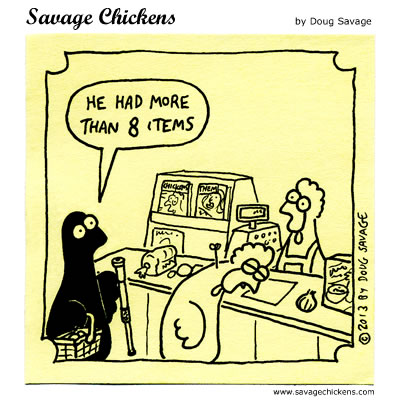
Tell the truth: We’ve all wanted to do that.
Posted in Think about it. | Comments Off on Express Lane
28th July 2013
David Friedman thinks of cool stuff so that you don’t have to.
Malthus started with the observation that humans like sex, and sex produces babies. He concluded that, unless there were large costs to producing babies, population would increase at something close to the biological maximum, leading to an exponential growth rate high enough to overcome any plausible rate of increase in human productivity. Looking around him, he observed that most people were poor enough so that the cost of supporting an additional child was a substantial burden. He concluded that if that was not the case, if, as Godwin and Condorcet, the authors he was responding to, expected, the future saw a sharp rise in the standard of living of the masses, making additional children only a minor burden, population would increase rapidly and the pressure of population against a fixed supply of land would push standards of living back down.
It’s an elegant argument and provides a plausible explanation for most of human history, but one that stopped working within the lifetime of its author. Why? What went wrong with Malthus’ model?
Posted in Think about it. | Comments Off on The Puzzle of the Other Hockey Stick
28th July 2013
Jerry Pournelle, whom you really ought to be reading all the time.
Democracies endure until the majority learns that it can vote itself largess from the public treasury. Up to that point awarding yourself money for doing nothing was known as graft. Old Ed Crump, the highly popular and successful city boss of Memphis when I was growing up, used to talk about ‘honest graft’ dishonest graft. Honest graft was the sort of thing like knowing where a road would be built or improved and tipping off your friends to buy out in that direction. Dishonest graft was stealing money from the treasury or intimidating taxpayers. Crump talked openly about it: he didn’t put up with theft and embezzlement and incompetence, but he rewarded efficiency and honesty. Oddly enough, most people believed him, and did so all the time I was in Memphis. I haven’t been back since. I suppose there has been some kind of debunking and posthumous degrading of the old man since I left in 1950.
Unfortunately, most of our politicians grew up reading Rawls, who just assumed that a pie drops magically from the sky and spent all of his time obsessing about how it was going to be divided; his intellectual progeny spend all their time focusing on distribution and not enough of it on production, with results as you see them.
Moore’s law is inexorable. We can do more and more with less and less. The precision gyros and accelerometers in a Minuteman missile cost millions of dollars. Now you can get a full set of gyros and accelerometers with a GPS receiver to boot on a chip for under $50, and that cost is falling. You can build a satellite capable of doing crop forecasts for a few thousand dollars and get it launched as a cube sat. Telemetry is no longer expensive – the batteries cost more than the electronics. In the early days of spy satellites we had to drop physical film packages and catch them off Hawaii before they fell into the sea to get good pictures of the Soviet ICBM installations. Now a cubesat can give you an instant picture at much better resolution.
Posted in Think about it. | Comments Off on Someone Has to Make the Pie.
27th July 2013
David Friedman ponders the distinction between laws and social norms.
You observe a stranger, in public, in possession of what is obviously stolen property of significant value. You might ignore it, but you also might call the police.
Unless it’s a shopping cart. The value of a shopping cart is about a hundred dollars and any that you observe outside the grocery and associated parking lot are almost certainly stolen. Yet, in practice, you do not call the police. My guess is that practically nobody does—or that the police don’t come, or that if they come they make no effort to arrest the thief. The basis for that guess is casual observation—if there were any significant chance that walking off with a shopping cart would get you arrested, tried, and jailed with a sentence suited to the value of the cart, very few people would do it.
Posted in Think about it. | Comments Off on Laws, Norms and Shopping Carts
27th July 2013
Read it.
Earlier today I spent some time with Andrew, his lovely and talented girlfriend Naomi Brockwell, and several other liberty-loving folk (btw, thanks Frayda & Ken!). Andrew observed that professional politicians are unique among professionals in denying membership in their profession. No electrician who arrives at your home to repair your electrical wiring announces that he’s emphatically not a professional electrician. No physician whom you visit to set your broken leg or to relieve your hemorrhoids eagerly lies to you that she is most certainly not a professional physician. Yet the typical professional politician is forever announcing that he or she is not a professional politician.
Posted in Think about it. | Comments Off on From the Monkey Cage
27th July 2013
Gavin MacInnes tells all.
One of the best things about living in the country is how little you care about “city” issues such as the Peruvian Kraut who killed a gangster’s son or a bunch of savages rioting halfway across the world. Here in upstate NY where nature’s tranquility meets summer’s heat, you sweat the small stuff.
Posted in Think about it. | Comments Off on Sweating the Small Stuff
27th July 2013
Everybody wants to be Hank Williams, but nobody wants to die.
Posted in Think about it. | Comments Off on Today’s Words of Wisdom
27th July 2013
Read it.
British interests have been represented for decades by the same person who embodies the non-political customs and traditions of the U.K. In the U.S., every four years America could be represented by someone who has a different sense of what it means to be an American than whoever previously lived in the White House.
And far too often they get it wrong: Woodrow Wilson. Teddy Roosevelt. Franklin Roosevelt. Lyndon Johnson. Bill Clinton. Barakc Obama. ‘Nuff said….
Although not granted their position in virtue of their birth, American presidents enjoy some lifestyle perks that are similar, if not superior, to the perks the British royal family enjoys. The White House is a mansion that resembles a palace, yet the British prime minister, the most powerful politician in the U.K. and the American president’s counterpart, gets to live in the comparatively modest 10 Downing Street, an attached office and living area that does not have the absurd amenities that the president enjoys in the White House, such as a bowling alley, swimming pool, tennis court, and cinema. Neither the Queen nor her prime minister get a security detail anywhere near as large as the American Secret Service.
One of the chief benefits of monarchy is perspective — Queen Elizabeth has seen every political fad cone and go for over 60 years, and probably isn’t impressed by any of them. There’s an amusing story that in her final days Queen Victoria was presented by the War Office with proposals that were characterized as ‘entirely new’. After reviewing them, she allegedly responded, ‘No, Mr Bannerman. Lord Palmerston presented me with these exact same proposals in 1852. And Lord Palmerston was wrong.’ That’s the sort of perspective the American government has always lacked at the top.
Posted in Think about it. | Comments Off on The Benefits of Monarchy
27th July 2013
Read it.
Even a blind pig finds an acorn every now and again.
Posted in Think about it. | Comments Off on PBS Explains Why Biotech Crops Are Really Good for People and the Environment
27th July 2013
Read it.
Really, they deserve what they get.
Posted in Think about it. | Comments Off on Poll: New Yorkers Don’t Want Weiner to Pull Out
27th July 2013
Read it.
Who would know better what a piece of shit this law is?
Posted in Think about it. | Comments Off on The IRS Workers’ Union Also Wants Exemption from ObamaCare
27th July 2013
Read it. And watch the video.
America’s renewable fuels policy is a fiasco that drives up the cost of both fuel and groceries, to no purpose. Well, there is a purpose: lots of people are making money off the renewable scam. But probably not you.
Posted in Think about it. | Comments Off on The Renewable Fuels Scam, Explained
27th July 2013
Read it.
Just think what they could do with the government.
Think about getting your driver’s license renewed. Now think about checking it at a car rental counter. Why can’t the former be as efficient as the latter?
Posted in Think about it. | Comments Off on In Lieu of Money, Toyota Donates Efficiency to New York Charity
25th July 2013
Freeberg waxes philosophical.
The thing that is not pointed out, is this: Humans who live in civilized societies, have a hunger for, and a fascination with, equality; the idea that anybody can grow up to become anything. Humans who live in civilized societies have a hunger for, and a fascination with, inequality as well. Deep down, we are programmed to admire the caste system. It’s in our wiring. In fact, we have to do some work to get away from it. Here in America, we consider that our patriotic duty. The “don’t care about the baby” types have completed that intellectual struggle, and they perceive, wrongly in some cases, that the “look at that pretty dress Kate’s wearing” people have not done this and therefore have betrayed their birthright.
It has been made a sensitive issue now that we are living in the age of Obama. All Americans with common sense and a decent, working, long-term memory, have seen how this glorification of living idols can mask over — and perhaps encourage — glaring and dangerous defects in judgment on the part of those living idols, or on the part of their peers or subordinates. For those who lack this working long-term memory, there are the stories of Bob Filner and Anthony Weiner. More democrat men tripping over their own dicks. Twice in rapid succession, we get to repeat the Kennedy/Clinton/Hart/Edwards/Spitzer waltz, with the moves now committed to muscle memory: Contrite apologies in front of banks of microphones, with the wife dutifully standing by…which everyone knows are just apologies for having been caught. We also know the wife isn’t standing by out of love, she’s standing by as a business partner, because with democrat politicians that’s what the wife is. And, since the unfaithful husband is a democrat, there will be the expected and obligatory defiant refusals to step down. The democrats can’t fail standards they never had in the first place. Oh yeah, and “blah blah blah performance in public office blah blah blah private life.”
Posted in Think about it. | Comments Off on Filner, Weiner and the Fresh Prince
25th July 2013
Steve Sailer looks out at the wasteland of American political thought.
With Barack Obama solemnly recounting for us last Friday how being black in America has personally burdened him, race is back in the news.
Actually, race is always in the news. Still, it’s worth using this particular intersection of inanity—during which the president and the Attorney General have made themselves look more foolish than Geraldo Rivera—to think through the most important question about race in the 21st century: How horrible would it really be if it became respectable to discuss racial realities seriously and intelligently?
Oh, as if THAT would ever happen….
The lesson that the prestige press tells us to take away from the Trayvon affair is that “profiling” (i.e., pattern recognition) inevitably leads to murderous frenzies. Some of the virulence of the media’s denunciations of George Zimmerman for putatively profiling stems from an underlying chain of logic in elite thinking that I find scary: If young black males really do tend to be more crime-prone, then…oh, no, the Nazis were right! So if Americans ever become embarrassed by the insipid political correctness we instruct them to spout, they will immediately thaw out Hitler’s cryogenically preserved brain and elect it president. Or something.
Not so much a Slippery Slope as a Cliff.
The day before the president’s speech about the “historical context” behind the Obama Administration’s War on Zimmerman, Detroit announced bankruptcy. Should Detroit’s failure be assessed within the context of four decades of black rule, the first 19 years under the overtly anti-white Coleman Young?
Whether it should or not, it won’t be. The Left spends most of its day with fingers jammed in ears saying LALALALALALALA.
Posted in Think about it. | Comments Off on Occam’s Butter Knife
24th July 2013
Ron Unz turns over a rock.
My expectations proved entirely correct, and the correlations between Hispanic percentages and local crime rates were usually quite close to the same figures for whites, strongly supporting my hypothesis that the two groups had fairly similar rates of urban criminality despite their huge differences in socio-economic status. But that same simple calculation yielded a remarkably strong correlation between black numbers and crime, fully confirming the implications of the FBI racial data on perpetrators.
Posted in Think about it. | Comments Off on Race and Crime in America
24th July 2013
Read it.
My, what a surprise! Aren’t you surprised? I’m sure surprised.
I am sitting in my air-conditioned house, where it is 75 degrees, and I need light bulbs. Do I go outside where it is 100 degrees and drive the half-mile to Target to get them, or do I click with my mouse to get them cheaper and wait for two days for them to arrive at my doorstep? The question answers itself.
Posted in Think about it. | Comments Off on Thanks to Smartphones, Amazon Is Softly Killing Retail Shopping and Is Better at It Than Google
24th July 2013
Read it.
No wonder Bloomberg wants to ban it — the Crust don’t want their children to have the competition.
Posted in Think about it. | Comments Off on Humble Iodized Salt Gave US a 10-Year IQ Boost, Say Researchers
23rd July 2013
Read it.
Not really news, but a useful reminder.
Posted in Think about it. | Comments Off on Paul Ehrlich Wrong Again: World Cereal Production Set to Reach Historic High
23rd July 2013
Read it.
Think of it as evolution in action.
Posted in Think about it. | Comments Off on Experience: My Partner Was Killed by a Barbecue
23rd July 2013
Baron Bodissey at Gates of Vienna allows us a peek into his life.
Why is Gates of Vienna dangerous?
Two possibilities suggest themselves. The first is the obvious one: speaking out in the manner commonly seen at this site may result in the loss of employment, official harassment, intimidation, and/or arrest (at the hands of the civil authorities). It may also invite death threats, physical attacks, serious bodily injury, and/or death (at the hands of Muslims or the thugs of UAF and its ilk). So danger lurks on all sides for anyone who decides to publicly oppose the Islamization of Britain.
Yet there is another kind of danger in such activities for those who inhabit the privileged heights of British society: ostracism, loss of status, being dismissed from a lucrative sinecure and forced to take a lesser one, the contempt and mockery of one’s peers, etc. It takes a steel backbone to endure to this sort of treatment and remain upright.
Posted in Think about it. | Comments Off on Fear and Loathing in the City of Westminster
22nd July 2013
Read it.
Shocking news! Washington state officials have discovered that hiking taxes on cigarettes way above that inflicted on the residents of neighboring states gives people reason to buy smokes in bulk across the border and peddle them to bargain hunters. Who ever would have guessed? Well, aside from anybody with a brain, that is.
My, what a surprise! Aren’t you surprised? I’m sure surprised.
Nationally, cigarette smuggling is a big business, largely because taxes have been hiked sky-high in a nanny-state effort to deter smoking. Putting the emphasis on neo-prohibitionism rather than revenue has resulted in 60.9 percent of cigarettes consumed in New York being sourced from the black market. The Bureau of Alcohol, Tobacco and Firearms (that’s a party!) says state governments lost $5 billion in 2010 because Americans preferred to purchase black market cigarettes rather than get mugged by the authorities.
State officials could lower cigarette taxes to take the profit out of smuggling, but they’d rather use the tax code to send a message. That message seems to be that going to the black market is a great way to save a buck — or make a mint.
Posted in Think about it. | 2 Comments »
22nd July 2013
Dymphna connects the dots.
Perhaps because there is a disappointing lack of widespread “burn-baby-burn-and-bust-me-some-cracker-heads” outbreaks across the country, our President chose to make a surprise speech today. That is, the occasion was a surprise, but the speech was the usual narcissistic insertion of himself into the story in order to generate a crisis. The man loves crises but mostly all he’s managed to create are scandals. And they go on and on. So he needs the race riots he keeps begging for.
So now we have a disgraceful and profoundly disrespectful ‘spontaneous’ speech about how he and Trayvon are soul mates. Trayvon Martin was a throw-away kid. He’d been suspended from school numerous times and was headed to a life as a petty criminal. He lived among various relatives because no one wanted him from Day One. Obama, on the other hand, was – and remains – a child of privilege. Though he and his groomers have done their best to erase the man’s past, we know he went to private schools until he hit Columbia. And his way was paid through private Harvard Law School, though we have little to no access to his records there or to his writings before his ascent to the White House. There is a short recording somewhere of an interview when he was a state senator.
Posted in Think about it. | Comments Off on Why Is Obama Trying to Start a Race War?
21st July 2013
Read it.
And who are still in charge of our foreign policy today.
War makes for strange bedfellows. Among the oddest pairings that World War II produced was the bringing together of William “Wild Bill” Donovan, head of the U.S. Office of Strategic Services (OSS) — a precursor to the CIA — and a group of German Jewish Marxists he hired to help the United States understand the Nazis.
Posted in Think about it. | Comments Off on The Marxists Who Explained the Nazis to Washington
21st July 2013
Read it.
Voter ignorance and elite ignorance are in fact closely related. If the voters were more knowledgeable, they could select candidates who demonstrate a deep understanding of policy issues and, to paraphrase Kaiser, “know and care more about substance than politics.” But in a world where most people don’t even know the name of their representative, they are unlikely to be able to evaluate his or her knowledge of policy issues. Moreover, evaluating that knowledge would require the voters themselves to know more about policy than most of them actually do. In this way, voter ignorance helps produce political leaders who are often ignorant themselves, albeit not quite to the same degree.
Posted in Think about it. | Comments Off on Political Ignorance in Congress
21st July 2013
‘Consumption is the sole end and purpose of all production; and the interest of the producer ought to be attended to only so far as it may be necessary for promoting that of the consumer. The maxim is so perfectly self-evident that it would be absurd to attempt to prove it. But in the mercantile system the interest of the consumer is almost constantly sacrificed to that of the producer; and it seems to consider production, and not consumption, as the ultimate end and object of all industry and commerce.’ — Adam Smith
So much for ‘intellectual property’.
Posted in Think about it. | Comments Off on Quote of the Day
21st July 2013
Read it.
These findings weren’t new. Seven previous studies had already shown that vitamins increased the risk of cancer and heart disease and shortened lives. Still, in 2012, more than half of all Americans took some form of vitamin supplements. What few people realize, however, is that their fascination with vitamins can be traced back to one man. A man who was so spectacularly right that he won two Nobel Prizes and so spectacularly wrong that he was arguably the world’s greatest quack.
Why take a chance? That’s all I’m saying….
Posted in Think about it. | Comments Off on The Vitamin Myth: Why We Think We Need Supplements