Farming arose on multiple continents among populations with radically different cultures and environments and with no means of communicating with each other – how did it crop up independently at about the same time?
Posted in Think about it. | Comments Off on The Biggest Coincidence in Human Evolution
A conservative commentator on Wednesday asked Irish Prime Minister Micheál Martin why he allowed American comedian Rosie O’Donnell to move to the country.
“Ireland is known for very happy, fun-loving people,” Brian Glenn, a conservative commentator for the digital media company Real America’s Voice, began a question to Martin during an Oval Office meeting with President Trump. “Why in the world would you let Rosie O’Donnell move to Ireland?”
“Thank you, I like that question,” Trump interjected as Martin nervously laughed while seated next to the president in the Oval Office. “Did you know you have Rosie O’Donnell? Do you know who she is?”
Martin did not respond before Trump added, “You’re better off not knowing.”
Posted in Think about it. | Comments Off on Conservative Commentator Asks Irish PM Why He ‘Let’ Rosie O’Donnell Move to His Country
As concerns swirl over the impacts of steep new tariffs on U.S. companies and consumers, so too does talk about how certain businesses try to avoid them.
‘Certain’ businesses? ALL businesses will try to avoid them; some more successfully than others.
President Trump’s long-threatened taxes on imports from China, Mexico and Canada took effect Tuesday, prompting retaliatory measures on American exports, roiling the stock market and fueling fears of an economic downturn.
Underscoring the fact that interference with trade is always an Unfriendly Act.
On Wednesday, Trump granted automakers a one-month reprieve from the tariffs, underscoring the unpredictability — and potential wiggle room — in his administration’s trade policy. On Thursday, he signed executive orders lifting tariffs on many Mexican and Canadian goods until April 2.
Trump is not a politician, and therefore not concerned much with ‘predictability’. He’s a businessman, and ‘wiggle room’ is what business is all about.
“I’m really interested to see how much of these threatened tariffs stick, and how many of our big industries will be able to get immediate reprieves like the auto industry has already done,” says Mary Anne Madeira, an assistant professor of international relations at Lehigh University. “And I’m hopeful that industries will get a lot of big carveouts and exemptions in a way that will really reduce the potential pain.”
Looks as if they had to reach way down the academic food chain to find somebody who would give them the credentialed comment they were looking for.
Posted in Think about it. | Comments Off on A Look at Some of the Creative Ways Companies Try to Dodge High Tariffs
New evidence indicates that Arctic areas with the thickest ice today probably melted out every year during the summer for about 1,600 years during the early Holocene (ca. 11.3-9.7k years ago), making the Arctic virtually ice-free. As I argue in my new book, this means that polar bears and other Arctic species are capable of surviving extended periods with ice-free summers: otherwise, they would not be alive today.
Posted in Think about it. | Comments Off on New Evidence That Polar Bears Survived 1,600 Years of Ice-Free Summers in the Early Holocene
More than a century before the Eurostar and LeShuttle, a group of engineers and statesmen dreamed (and fretted) about connecting Britain to France with an underwater tunnel. Peter Keeling drills into the history of this submarine link, and finds a still-relevant story about the cosmopolitan hopes and isolationist panic surrounding liberal internationalism.
Posted in Think about it. | Comments Off on Liberal Visions and Boring Machines: The Early History of the Channel Tunnel
One of my biggest fears is that the manufacturer of a smart home product I use will go bankrupt and disappear overnight. It’s not an unfounded fear — just last year, smart home company Insteon abruptly announced that it would shut down its servers over financial difficulties. The servers would later return from the dead, but only because some loyal users acquired the entire company to keep its products alive. This isn’t a one-off example either — Philips stopped supporting its first-gen Hue Bridge in 2020 and MyQ’s garage door openers became incompatible with the Google Assistant without warning in 2023.
Many also care about the privacy implications of having cheaply made devices connect to the internet, but that’s a relatively smaller concern for me. Nevertheless, an offline smart home setup insulates me from both potential bankruptcy and privacy invasions.
Posted in Think about it. | Comments Off on How I Built a Fully Offline Smart Home, and Why You Should Too
The rise of digital communications has been a boon but has also opened society to grave risks through cyber war. Ukraine found this out in the first years of its war with Russia. Just as worrying has been the penetration of television, the internet and streaming radio by hacker groups, both military and criminal. Attempts to change the narrative of society and sow discord through fake news and false information, denial-of-service attacks and interference with GPS signals have all been a serious challenge in the ongoing war. Ukraine has hit back with its own hacktivist networks, even disrupting Moscow television stations, and the cyber war continues.
Last year, in the United States, the FBI revealed the existence of a massive penetration of American telecommunications networks by China, conducted by a threat group dubbed ‘Volt Typhoon’. It had taken vast amounts of data about Americans, including text messages, and perhaps inserted malware into networks. This complex cyber-attack against routers and switching networks could have been ongoing for years. More recently, the spate of sabotage against data cables on the floor of the Baltic sea, involving Russian-linked or Chinese vessels, has raised alarm about communications and internet vulnerabilities for Nato allies.
Somtimes the old ways are best.
Posted in Think about it. | Comments Off on Bring Back Shortwave!
Artificial intelligence has discovered ancient civilizations over 5,000 years old hidden beneath some of the world’s largest deserts, including one in the heart of the Dubai desert, without the use of a single shovel. In the Dubai desert, remains of human activity over 5,000 years old have been detected, including a buried city.
The discovery in the Dubai desert revealed ancient settlements and communication networks, indicating the presence of roads and settlements.
Advancements in remote sensing and data analysis using artificial intelligence have transformed archaeology, improving the efficiency and effectiveness of excavations. The integration of AI and Synthetic Aperture Radar (SAR) proved especially powerful. SAR technology provides high-resolution images of structures buried beneath the earth’s surface, capable of penetrating natural barriers such as sand, vegetation, and ice.
Posted in Think about it. | Comments Off on Artificial Intelligence Finds 5,000-Year-Old Civilization Beneath Dubai Desert
On the wall of his living room in Lier, Belgium, Werner van Beethoven keeps a family tree. Thirteen generations unfurl along its branches, including one that shows his best known relative, born in 1770: Ludwig van Beethoven, who forever redefined Western music with compositions such as the Fifth Symphony, Für Elise, and others. Yet that sprig held a hereditary, and potentially scandalous, secret.
That Beethoven, Werner learned to his dismay in 2023, is biologically unrelated to Werner and his contemporary kin. This uncomfortable fact was brought to light by Maarten Larmuseau, a geneticist at KU Leuven who specializes in answering a question relatively few others have explored: How often do women have children with men they’re not partnered with?
In most societies, kinship is at least partly socially constructed, and for example can include adoption and stepfamilies. Yet questions about biological paternity have roiled families and fueled cultural anxieties for eons. Male authors have written about hidden paternity for millennia, including in Greek dramas and The Canterbury Tales; William Shakespeare and Molière wrote plays about it. Knowing a child’s biological father is also important for forensically identifying cadavers, recording accurate medical histories, and charting the manifold ways in which people structure families around the world.
Posted in Think about it. | Comments Off on Paternity Detective
I’m a professor of economics at George Mason University and today I’m going to share my screen and we are going to be talking about President Trump’s crypto executive order and what it means for American innovation, crypto taxation, and the global dominance of the dollar. Okay, so let’s get going. I’m going to pull several key sentences from the crypto order, including the first promoting and protecting the sovereignty of the United States dollar, including through actions to promote the development and growth of lawful and legitimate dollar backed stable coins worldwide. So first of all, what’s a stable coin? Well, we all know the price of Bitcoin and Bitcoin fluctuates. It’s 120, it’s 80 today. It goes up and down. It’s actually not a good transactions medium for that reason. So despite what Satoshi Nakamoto wanted, it’s not a good transactions medium. Stable coins, in contrast to Bitcoin are designed to maintain a stable value, typically relative to an already established currency.
Posted in Think about it. | Comments Off on President Trump’s Stablcoin EO: What It Means for American Innovation, Crypto Taxation, and Global Dominance
NATO is turning to the ongoing war in Ukraine for lessons as the alliance works to shift its strategy going forward. Tom Goffus, NATO’s Assistant Secretary General for Operations, presented five such lessons during a panel this week at the Air and Space Forces (AFA) Air Warfare Symposium in Aurora, Colorado.
“I got to NATO one month before the invasion, so [I had a] front row seat watching the whole thing,” Goffus told the audience. “I think it’s a critical topic.”
Prior to that, Goffus, a former U.S. Air Force F-15 pilot, served as Policy Director on the U.S. Senate Armed Services Committee, Deputy Assistant Secretary of Defense for European and NATO Policy, National Security Staff Director for Strategic and Eastern European Affairs, and Senior Military Advisor for European and Eurasian Affairs at the State Department.
Before unveiling his own takeaways, Goffus talked about the value of Ukraine’s acoustic sensor network for the detection of low-altitude detection of drones and cruise missiles.
“Essentially, Ukraine is covering its entire nation, 1,000 meters and below, with acoustic sensors for less than 50 million euros (nearly $54 million),” Goffus gushed. “It’s crazy what they’re doing with this.”
Posted in Think about it. | Comments Off on NATO Operations Chief’s Five Lessons Learned From War in Ukraine
Five hundred million Europeans begging 300 million Americans to defend them from 140 million Russians. If you can count, count on yourself. Not in isolation, but with full awareness of your potential. Today, in Europe, we do not lack economic strength, people, but the belief that we are a global power.
Posted in Think about it. | Comments Off on Quotation of the Day
The venture capitalist Marc Andreessen is one of the most forthright individuals in Silicon Valley. Yet even this billionaire maintains that his fellow elites have been muzzled. Interviewed by Joe Rogan last November, Marc Andreessen said that many of his fellow tech entrepreneurs had been debanked by the Biden administration. The Obama administration, he said, had taken such action against marijuana businesses, escorts and gun shops; Biden’s, he said, pursued tech founders, preventing them from receiving payments, making them, or buying insurance. “This is one of the reasons why we ended up supporting Trump,” he told Rogan.
Debanking is when a bank closes an account in order to censor or punish the customer for political or religious views. The banks, in these cases, are typically responding to ideological pressure or to perceived reputational risk. As you might imagine, anger over debanking rapidly merged with concerns shared by crypto companies, which have also contended with access issues to traditional banking. One CEO shared a letter in which the bank Chase said it was closing his company’s account.
The complaints about debanking were echoed and amplified by Donald Trump. His wife, Melania, claims that she herself was debanked. More broadly, the MAGA movement has ample experience of being booted off social media platforms. The matter of tech debanking, therefore, has been rolled into existing MAGA complaints. By this account, the US government has restricted freedom of expression via several coercive means.
Posted in Think about it. | Comments Off on Corporate America’s Dirty Trick
In the case-control study, individual-level analysis resulted in a hazard of skin cancer (of any type except basal cell carcinoma) that was 1.62 times higher among tattooed individuals (95% CI: 1.08–2.41). Twin-matched analysis of 14 twin pairs discordant for tattoo ink exposure and skin cancer showed HR?=?1.33 (95% CI: 0.46–3.84). For skin cancer and lymphoma, increased hazards were found for tattoos larger than the palm of a hand: HR?=?2.37 (95% CI: 1.11–5.06) and HR?=?2.73 (95% CI: 1.33–5.60), respectively. In the cohort study design, individual-level analysis resulted in a hazard ratio of 3.91 (95% CI: 1.42–10.8) for skin cancer and 2.83 (95% CI: 1.30–6.16) for basal cell carcinoma.
As with most such studies, this documents correlation, not causation, and therefore isn’t worth as much as it pretends to be.
Nevertheless, it’s comforting to know that, like tobacco and alcohol and opiates, this tends to be a self-correcting problem. Think of it as evolution in action.
Posted in Think about it. | Comments Off on Tattoo ink exposure is associated with lymphoma and skin cancers – a Danish study of twins
While we think of today’s metric system (SI) as mostly a modern invention (1960), we have been led to believe for many years now that its most fundamental base unit, the metre, originated in France in 1793, and represented one ten-millionth of the earth’s quadrant (the distance from the earth’s equator to the North Pole, as measured at sea level) . Yet just a few years ago, the late Pat Naughtin discovered that the proposal for a universal standard of length very close to the metre may in fact have originated much earlier, via Bishop John Wilkins, an English cleric and philosopher, and a member of the Royal Society, in the mid-1600s. Recent comments on Metric Views now bring even that assertion into doubt, with the discovery of a measuring device called the wand having been around much longer still.
It is known that the wand, divided into ten segments, was almost exactly, to within a few millimetres, the same length as today’s metre, and that it was used as long as 1000 years ago. But what if all these versions of the metre were simply the rediscovery (or the handing down over time) of a standard measure, equating to the metre, that was invented in Egypt over 4500 years ago?
When we think of units of measure used in Biblical times, the cubit usually springs to mind. In fact, opponents of metric conversion have often referred to the cubit, in jest at least, as having as much validity as the metre. Such people should be careful for what they wish for, for, as we shall see, the cubit and the metre may in fact be directly related – and remarkably both are directly traceable to the Great Pyramid at Giza.
Posted in Think about it. | Comments Off on The Meter, Golden Ratio, Pyramids, and Cubits, Oh My
Robert Higgs coined the term regime uncertainty to illustrate the challenge faced by business under Franklin Roosevelt’s New Deal, when a flurry of unpredictable legislation such as the expansive and often unclear mandates of the National Industrial Recovery Act (NIRA), attempts at court packing, abrupt tax increases, and shifting labor policies, meant businesses couldn’t reliably forecast returns or risks. Uncertainty magnified bad policy causing investment to collapse and remain unprecedently low.
For the eleven-year period of 1930 to 1940, net private investment totaled minus $3.1 billion. Only in 1941 did net private investment ($9.7 billion) exceed the 1929 amount.
The data leave little doubt. During the 1930s, private investment remained at depths never plumbed in any other decade for which data exist.
Posted in Think about it. | Comments Off on Regime Uncertainty
The majority of our exports to China are raw products like petroleum and soybeans, the two largest categories being exported, while the majority of China’s exports to the United States are manufactured products like computers and other technical equipment.
We send corn and sorghum to China, they ship us back batteries and toys. We sell them coal and ores, they sell us circuit boards and car parts. We ship them tanned hides and meat, and then receive back optical fibers and medical equipment.
Advanced societies buy raw resources from backward societies and sell them back the manufactured goods. We export scrap metal to China, they send us back steel. We send them scrap copper, they ship us back the equipment of which that copper is a component. We export polymers and import the finished ‘Made in China’ plastic products that fill up our stores.
Posted in Think about it. | Comments Off on Trading Soybeans for Computers
Thirty-odd yards ahead of me, a body lay on the sidewalk in a large puddle of blood. I joined a loose throng of locals, mostly adolescent males, walking towards the mishap. A burly black sergeant with a commanding air stood over the corpse of an Asian shopkeeper while several subordinates established a perimeter. It looked like the shopkeeper had been robbed, chased the felon outside, and was shot dead for his efforts. The big cop slowly scanned the young black males who had gathered to watch the unfolding drama. He seemed to pause here and there as if to memorise faces. Then he shook his head and snarled, “If I get my hands on the nigger who did this…”
He left the sentence unfinished, but the way he glowered at the youths in the crowd left no doubt about his intended meaning. We now live in an era when every instance of police brutality fast becomes a cause célèbre on TikTok. But back then, it was understood that cops would mete out street justice to those who committed heinous crimes like the one I’d stumbled upon. In a scene from the contemporaneous Joe Wambaugh series Police Story, a plainclothes detective at a crime scene gets on the police radio and calls for an ambulance. The uncooperative perp he has been questioning asks what the ambulance is for, to which the cop replies, “Because of the leg you broke getting into the squad car.”
Having no appointment to rush to, I studied the arriving auditors of unnatural death as they went about their business, photographing, measuring, dusting, and collecting evidence. The scene was, in its way, as hypnotic as the flashing lights—but it was not what I found unforgettable about that day (I’d seen dead bodies on sidewalks before, and would see them again). Rather, what stays with me even a half-century later is this: I grew up in the Brooklyn of Spike Lee’s Do the Right Thing vintage, yet the first time I heard someone call someone else a nigger and really mean it, the word came out of the mouth of a black cop, who spat it at dozens of other young black men.
Posted in Think about it. | Comments Off on The Worst Racial Slur, In Context
…we started with ChatGPT, but are now seeing a proliferation of industry specific tools. Some people have called these startups “LLM wrappers”; those people are missing the point. The O ring model in economics shows that in a process with interdependent tasks, the overall output or productivity is limited by the least effective component, not just in terms of cost but in the success of the entire system. In a similar vein, we see these new industry specific AI tools as ensuring that individual industries can properly realize the economic impact of LLMs, and that the contextual, data, and workflow integration will prove enduringly valuable.
Examples in this vein include Abridge, Nabla, and DeepScribe, which are rethinking medical and patient care, while Studeo is reshaping how real estate businesses market property. Architects are using SketchPro to instantly render designs with simple text prompts, restaurants are using Slang.ai to take phone reservations, and property managers are unifying customer support with HostAl. Harvey, whose Al legal assistant is used by many Fortune 500 companies, quadrupled revenue in 2024.
Posted in Think about it. | Comments Off on Stripe’s Annual Letter
The title of this post is a reference to a Scandinavian sexploitation film from the early 1970s called The Sinful Dwarf. I never saw the flick — that sort of movie doesn’t appeal to me — but back in the day I saw a lurid ad for it in the back pages of the entertainment section of The Washington Post and the name stuck in my memory.
The sins of the Dwarf of Kiev are of a different sort. Mr. Zelensky got himself into hot water on Friday when he chose to get contentious with President Trump and Vice President Vance in the Oval Office. Maybe he forgot that he had come to the capital of the American empire to beg favors for Ukraine, and decided to bite the hand that fed him.
Or maybe he didn’t really make the decision. Maybe the contretemps was set up, prepared in advance, at least in its general outline. Mr. Trump and Mr. Vance may have been waiting for an opportune moment to steer events in a different direction, one that had been decided well in advance.
Posted in Think about it. | Comments Off on Time’s up for the Sinful Dwarf
Late Saturday, D.C. District Judge Amy Berman Jackson ruled that President Donald Trump violated federal law in firing Hampton Dellinger, head of the Office of Special Counsel. Jackson’s decision is forceful, well-written, and challengeable under existing precedent. Indeed, it may have just set up an appeal that both presidents and professors have long waited for to reinforce presidential powers.
Trump has been doing things that formally Presidents are allowed to do but that most of his predecessors have shied away from because doing so would be inconsistent with ‘how we do things today’. At the very least, it will hammer out (through the courts and otherwise) just what the President can lawfully do.
Posted in Think about it. | Comments Off on ‘Spoiling For A Fight’ – Judge Blocks Trump’s Firing Of Head Of Office Of Special Counsel
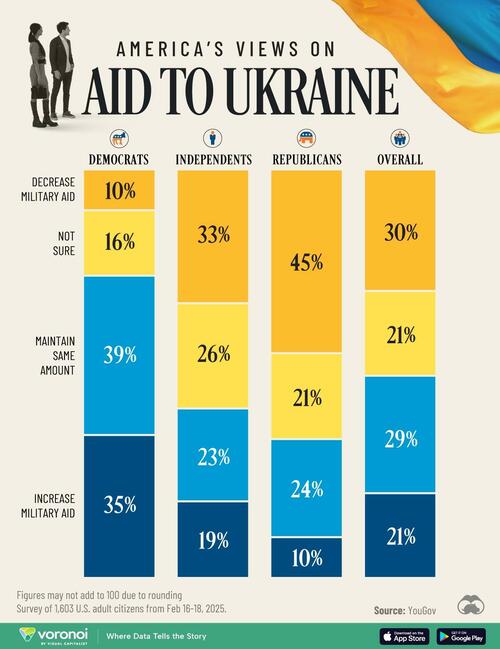
Is the rest of the world entitled to US money and US security? This is the question that’s never asked when the establishment media rages about Donald Trump’s opposition to continue the status quo in Ukraine. Consider for a moment the situation from the perspective of friends (allies).
Imagine a wealthy man is approached by his friends often for loans which these friends rarely pay back. He obliges out of generosity, but begins to suspect his friends are only interested in his wallet. So, he makes an announcement that he’s trying to get his finances in order and will not be lending any money for the next 90 days.
Do his friends respond with understanding? No. They call the man a criminal and cry endlessly about how their families will starve and the world will fall apart if he doesn’t keep filling their bottomless gullets with cash. They even suggest he is deserving of retribution for daring to ask them to support themselves.
With friends like these, who needs enemies?
Posted in Think about it. | Comments Off on European Reality Check: Without the US There Is No NATO and No Ukraine
In America’s most surprising cutting-edge classes, students pursue hands-on work with wood, metals and machinery, getting a jump on lucrative old-school careers.
School districts around the U.S. are spending tens of millions of dollars to expand and revamp high-school shop classes for the 21st century. They are betting on the future of manual skills overlooked in the digital age, offering vocational-education classes that school officials say give students a broader view of career prospects with or without college.
With higher-education costs soaring and white-collar workers under threat by generative AI, the timing couldn’t be better.
Posted in Think about it. | Comments Off on The Schools Reviving Shop Class Offer a Hedge Against the AI Future
The Washington Poop, a Voice of the Crust, has been invaded by a sane person. Let’s hope he gets out alive.
On the morning of March 10, I intend to take a shower, turn my face up to the spray and burble, “Thank God for the Guardian!” Not because I admire the left-wing politics of the British newspaper, where they seem to long for the days when the Brits’ income tax rate topped 90 percent and Nigel Farage hadn’t been born. No, March 10 will mark precisely one year since the Great Shower Debate ended.
Or at least it ended for me when the Guardian published an article with the immortal headline “High shower pressure can help people save water, study suggests.”
Intrepid researchers at the University of Surrey had placed sensors in 290 showers around campus, recording data for 39 weeks from 86,421 individual shower sessions. “Water consumption,” the study found, sensationally, “was reduced by up to 56% with high water pressure.”
Posted in Think about it. | Comments Off on Your Showerhead Is Lying to You
In time, Volodymyr Zelensky may be on that list of mercurial figures who somehow ended up on the world stage, only to come to a bad end. The former actor and comedian, who was never all that good at either role, has become both the indispensable man and the clog in the drain of history that must be removed for things to take their proper course. The great struggle now is between those two opposing realities, which helps explain last week.
The neocons turned Zelensky into a folk hero so he could be the point around which Western politicians would rally. Then he became the clearing house for cash that flowed into Ukraine, some of which flowed back out into the pockets of European and American politicians. This only worked if there was a war with Russia, so they worked with Zelensky to make negotiations with Russia impossible, short of the unconditional surrender of the Russians.
For Project Ukraine, Zelensky became the indispensable man. Trump comes to power, and he wants to wrap up Ukraine and move onto other things, but to do that he has to broker a deal between Ukraine and Russia. Of course, Zelensky cannot do this as his very existence rests on this war with Russia being a permanent feature of life. It is why his peace plans always revolve around the West joining the Ukrainians in the fight on the ground.
The blowup on Friday now creates a serious problem for the Europeans. Despite the tough talk from the soy boys and girl bosses, they cannot risk a genuine split with Washington. They think Trump is bluffing about cutting off Ukraine, but once they realize that he is not bluffing, they will confront the same issue Trump has observed. The thing clogging the pipes, preventing things from flowing in the proper direction is Zelensky, which means he will have to go.
Posted in Think about it. | Comments Off on Quotation for the Day
One cartel leader says he’s trying to figure out how to protect his family in case the American military strikes inside Mexico. Another says he’s already gone into hiding, rarely leaving his home. Two young men who produce fentanyl for the cartel say they have shut down all their drug labs.
A barrage of arrests, drug seizures and lab busts by the Mexican authorities in recent months has struck the behemoth Sinaloa Cartel, according to Mexican officials and interviews with six cartel operatives, forcing at least some of its leaders to scale back on fentanyl production in Sinaloa state, their stronghold.
The cartels have sown terror across Mexico and caused untold damage in the United States. But here in Culiacán, the state capital, the dynamic seems to be shifting, at least for now. Cartel operatives say they’ve had to move labs to other areas of the country or temporarily shut down production.
“You can’t be calm, you can’t even sleep, because you don’t know when they’ll catch you,” said one high-ranking member of the Sinaloa Cartel who, like other cartel operatives, spoke on condition of anonymity for fear of capture.’
Sometimes the system works.
Posted in Think about it. | Comments Off on Trump Threats and Mexico’s Crackdown Hit Mexican Cartel
The best way to understand Trump is also the simplest: he’s a businessman. From that perspective, little of what he’s doing is as inexplicable or surprising as many make it out to be. The inexplicability arises from general ignorance of business. Most Americans have little knowledge or understanding of how private American businesses work, although they generates the majority of the U.S.’s $29 trillion GDP and employ many of them.
Trump is now CEO of the federal government. That enterprise has over $36 trillion in direct liabilities and unfunded liabilities in the hundreds of trillions. Its cost of credit is rising and debt service is taking an ever-expanding share of its revenues. Self evidently, it cannot continue on its present course.
The common element of successful business turnarounds is that they don’t emerge from slow, incremental changes from within the system. Somebody comes in and administers shock therapy. Turnaround artists are never popular. Lots of people are fired, unprofitable operations discarded, finances tightened, business philosophies rethought, and the company’s direction radically reset. Because the company’s situation is dire, this all has to be done quickly, with shareholders howling and creditors pounding at the door.
Few of President Trump’s actions early in his second term have provoked as much furor as the executive order freezing certain federal spending programmes. A federal trial judge in Rhode Island issued a nationwide injunction against the freeze, insisting that he intends to stop the administration from “any federal funding pause”. Five former Treasury secretaries published a protest op-ed in The New York Times, warning that “not since the Nixon administration has this type of executive action been contemplated”.
They’re right about that. Trump’s assertion of the president’s power to pause funding — the right of impoundment — reverses the standard practice of the past two generations. Team Trump aims to restore the traditional exercise of presidential authority to impound congressional spending, a power which was restricted by the Impoundment Control Act of 1974. In doing so, the Trumpians aim to put an end to what political analyst Kevin Phillips called the “Watergate warp” that weakened American presidents, Republican and Democratic, pulling them down from the Caesarist heights summited by pre-Watergate chief executives.
The principle behind impoundments is simple. Congress has the authority to set the ceiling on spending, the thinking runs, but not the floor. If the goal of a programme is achieved without spending the full amount authorised by the legislative branch, the president can decide not to spend the difference. So argued FDR, a frequent user of impoundments. Forcing the president to spend every last dime, he said, “would take from the chief executive every incentive for good management and the practice of commonsense economy”.
If the legal battles over Trump’s executive order freezing some spending lead to a Supreme Court decision clarifying the constitutionality of impoundments — and holding the 1974 act unconstitutional — it would be a huge win for the administration, and they are gearing up for it. But legal battles are downstream of political ones. In Trump’s first term, the president was frequently stymied by coordinated media, legal, and security-apparatus efforts to generate public outcry. After some bluster, Trump usually withdrew to a more conventional position. But he is pulling no punches this time around, and noticeably, he doesn’t need to. The American people appear much less susceptible to supposed threats to “our democracy” than they were in 2017, and Trump’s approval ratings have climbed since he re-entered the Oval Office.
Posted in Think about it. | Comments Off on The Return of the American Caesar
It is abundantly clear that the US-NATO umbrella over Europe has achieved the complete infantilization of the Continent. Lacking the need to do anything serious in terms of core national interest (i.e., defense), Europe has entirely lost the plot.
There is no longer any justification for propping up Germany, or any nation that refuses to invest in its own national defense. Beyond that: the US should not be defending illiberal countries that arrest people for “mean tweets.” If the US pulls out, Europe gets the very sharp shock that it needs if it is going to wake up, defend against Russia, reduce the Nanny State, and deport Muslims.
Truly: the US should leave Europe – for its own good.
Concur.
Posted in Think about it. | Comments Off on The US Must Pull Out of Germany/Europe
Many Americans are pinching pennies, exhausted by high prices and stubborn inflation. The well-off are spending with abandon.
The top 10% of earners—households making about $250,000 a year or more—are splurging on everything from vacations to designer handbags, buoyed by big gains in stocks, real estate and other assets.
Those consumers now account for 49.7% of all spending, a record in data going back to 1989, according to an analysis by Moody’s Analytics. Three decades ago, they accounted for about 36%.
All this means that economic growth is unusually reliant on rich Americans continuing to shell out. Mark Zandi, chief economist at Moody’s Analytics, estimated that spending by the top 10% alone accounted for almost one-third of gross domestic product.
Makes you wonder why Democrats and other progressives keep trying to drive rich people out of the country. (Go Where You’re Treated Best)
Posted in Think about it. | Comments Off on The U.S. Economy Depends More Than Ever on Rich People
The last two commercial airline disasters had a woman in control of an aircraft, making critical errors. Both were beneficiaries of DEI policies that leapfrogged them ahead of more qualified candidates on the basis of their sex. In the first collision, the Blackhawk pilot did not remain spatially aware of her rotorcraft’s surroundings, and flew right into the path of the descending CRJ. And in the second collision, the rookie pilot, who may have been confused by the blowing snow, failed to flare her aircraft, and she slammed it into the ground. That everyone lived was a miracle, plain and simple.
This did not have to happen. Indeed, it should not have happened. It is a fact that men and women are different. And one of the basic physiological differences is that men have better spatial awareness for moving objects than women, while women have better color awareness than men. More than that (and highly relevant for the DCA Disaster): Men have an advantage over women in night vision due to the physical structure of the eye.
Of course, the Blank Slate crowd (not to mention the ‘assigned gender’ crowd) won’t accept any assertion of physical differences between men and women.
Posted in Think about it. | Comments Off on Sexism in the Skies: Spatial Awareness